


OVERWHELMING EVIDENCE' AGAINST A BLACK NURSE?

THEN
THE NMC EXAMINED THE CCTV AND THE ALLEGATION WAS NOT PROVED

E4BN examines how a serious medication allegation against a Black nurse developed into a dismissal and NMC referral, despite significant evidential questions.
She Was Accused of Attempting to Give a Vulnerable Patient the Wrong Medication.
She Lost Her Job. Her Employer Referred Her to the NMC.
But the CCTV Did Not Support Crucial Parts of the Accusation
What happened to this Black nurse should concern every nurse, ward manager, employer and healthcare regulator in Britain. Because an allegation is not a fact and an investigation is not necessarily a fair investigation.
By Equality 4 Black Nurses (E4BN)
AN ACCUSATION CAN TAKE MINUTES. CLEARING YOUR NAME CAN TAKE YEARS.
Imagine arriving for a night shift, preparing medication for your patient and carrying out the responsibilities you trained for.
Then imagine being accused of something every conscientious nurse fears: attempting to give a vulnerable patient somebody else's medication.
You insist that the accusation is wrong.
You question the evidence.
You ask for fairness.
But your employer proceeds with disciplinary action. You lose your job. Your professional conduct is reported to the Nursing and Midwifery Council (NMC).
Years pass before an independent regulatory panel reaches its conclusion.
The allegation that you attempted to administer the wrong medication is not proved.
For one Black nurse at Cygnet Hospital Hexham, this was the devastating reality of a case in which her professional future became entangled with a disputed medication incident.
And what emerged during the NMC proceedings raises questions far beyond one hospital.
How did an employer become so confident in a serious allegation when the CCTV could not establish crucial parts of what was said to have happened?
What happens to a nurse whose career and reputation are placed at risk before an allegation is properly established?
THE NIGHT SHIFT THAT CHANGED EVERYTHING
On 10 January 2023, the nurse, now supported by Equality 4 Black Nurses (E4BN), was working a night shift.
She attended to Patient E to administer prescribed medication.
The following morning, a white registered nurse, Amy, reported that the patient had alleged that the nurse attempted to give her medication intended for somebody else.
According to the reported account, the tablets looked different and the medication pot had two letters that did not represent Patient E's initials.
The patient was also said to have described the nurse leaving and returning with replacement medication.
These were serious allegations that required investigation.
But there is an essential distinction between taking a patient complaint seriously and treating an unproven allegation as established misconduct.
Patient safety demands thorough investigation. Fairness demands that the evidence is tested before conclusions are reached.
In this case, the CCTV would become crucial.
THE CCTV THAT CHALLENGED THE ACCUSATION

CCTV evidence was central to the NMC's consideration of the medication allegation. The panel did not find the alleged wrong-medication administration proved.
The footage did not contain audio.
It could not establish what either the nurse or the patient had said.
It did not clearly show the colours of the medication.
Most significantly, the recording did not show the nurse making the alleged second journey to collect replacement tablets.
Instead, the panel observed the patient accepting and taking medication before appearing to question something afterwards.
The NMC's written determination concluded:
"There is no evidence to indicate that you gave Patient E the wrong medication."
Those words matter.
The panel did not find that the nurse had attempted to administer the wrong medication.
A separate allegation about the medication pot was proved, but the central wrong-medication allegation had not been established.
And yet the nurse had already been dismissed, referred to her regulator and subjected to years of professional uncertainty.
The accusation travelled further than the evidence could take it.
HOW WAS THE NURSE IDENTIFIED?

Identification evidence must be carefully tested when an allegation may affect a nurse's career, reputation and professional registration.
During the hearing, E4BN questioned Amy about how Patient E identified the nurse involved.
The patient had not named the E4BN member and did not describe the person as Black.
Instead, Amy had asked whether the individual was the blonde-haired or dark-haired nurse.
Under questioning by the panel chair, Amy acknowledged offering those descriptions to the patient. She maintained that the answer corresponded with the nurse allocated to administer medication that night.
However, the patient did not attend the NMC hearing to give live evidence, and important elements of the reported account could not be reconciled with the CCTV.
These weaknesses raise questions about the reliability of the evidence.
When a nurse's professional future depends on identifying the correct person, that identification must be examined with exceptional care.
OVERWHELMING EVIDENCE' — BUT WHAT DID THE EMPLOYER ACTUALLY ESTABLISH?
Hospital manager Anthony Saiger watched the CCTV, chaired the disciplinary hearing and subsequently referred the nurse to the NMC.
During cross-examination, E4BN challenged the strength of the evidence relied upon by the employer. Anthony Saiger defended the allegation as supported by the evidence taken together.
Yet the objective material and identification evidence contained important limitations.
Despite those weaknesses, the employer pursued the allegation.
The NMC's eventual conclusion was materially different from the employer's confident account.
If an employer describes evidence as overwhelming, the nursing profession is entitled to ask whether that confidence is justified by what the evidence actually establishes.
An employer's confidence in an allegation must never be mistaken for proof.
The consequences of an allegation that is not ultimately proved are not confined to paperwork. They can affect employment, reputation, mental wellbeing and an entire professional future.
WHAT THE NMC FOUND — AND WHAT IT DID NOT
The NMC examined two distinct allegations under Charge 3.
Attempting to administer the wrong medication to Patient E: NOT PROVED.
Using a medication pot bearing another patient's initials: PROVED.
The nurse had acknowledged reusing a medication pot from an earlier medication round.
After the previous patient received their medication, she used that pot as a cover for Patient E's medication pot. The earlier patient's initials remained visible.
This was not best practice, and the panel found the use of the pot proved.
But the finding about the container must not be confused with proof that the nurse attempted to administer the wrong medication.
A medication pot bearing the wrong initials is not the same as a patient receiving the wrong drug.
That is a distinction every nurse, investigator and journalist should understand.
WHEN A WORKPLACE PRACTICE BECOMES ONE NURSE'S DISCIPLINARY CASE
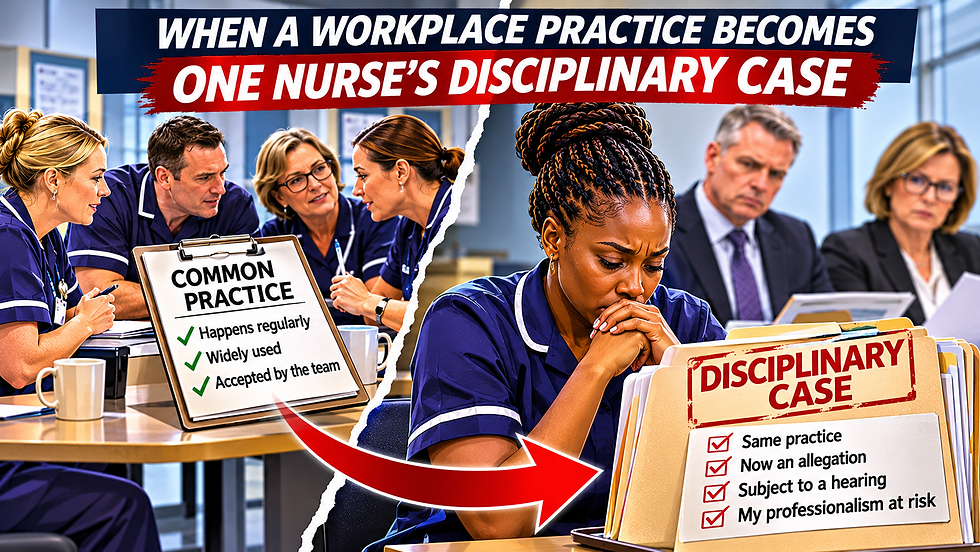
Consistent responses to medication practices matter for patient safety, workplace fairness and professional accountability.
During the proceedings, witneses acknowledged that other nurses had also used medication pots with patients' initials in similar ways.
This did not excuse the member's conduct.
But it raised an important question about how employers respond when an unsafe practice occurs among multiple members of staff.
Is the practice addressed through training and supervision?
Are staff treated consistently?
Are systemic weaknesses examined?
Or does accountability fall most heavily on the individual nurse whose conduct becomes the subject of disciplinary proceedings?
When an unsafe practice becomes established in a workplace, the responsibility to address it extends beyond one individual.
A fair investigation must examine not only what went wrong, but also whether the organisational response was consistent and proportionate.
THE DISCRIMINATION COMPLAINT THAT WAS NEVER SEPARATELY INVESTIGATED
Beyond the medication allegations, the hearing revealed a separate and deeply concerning issue: the employer's handling of the Black nurse's complaints of discrimination and victimisation.
In January 2023, she wrote to hospital manager Anthony Saiger raising concerns about her treatment, discrimination, victimisation and the effect on her wellbeing.
These concerns deserved consideration in their own right, regardless of any separate questions concerning clinical practice.
During the NMC proceedings, Anthony Saiger acknowledged that no separate formal grievance investigation had been opened into her complaints. He maintained that her concerns had been considered within the disciplinary process but disputed that he had treated her unfairly.
This admission becomes particularly troubling when considered alongside the evidence of Jamie, a white registered nurse.

Evidence heard during the NMC proceedings raised concerns about the handling of this nurse's discrimination complaint.
Jamie testified that he had personally heard Anthony Saiger make remarks such as:
"They're going to play the race card to get out of it." Jamie reinforced his account by stating:
"He would say things like that. And that's me being totally honest."
The evidence raises an uncomfortable question:
Was this Black nurse's complaint assessed with an open mind, or was it viewed through the very attitude towards racism that Jamie described?
This raises a deeper concern about anti-Blackness within workplace disciplinary processes.
Anti-Blackness is not limited to overt racist language. It can also manifest when Black professionals' concerns are dismissed, their credibility is questioned or their treatment is subjected to unequal standards.
The evidence in this case raises questions about whether such attitudes affected the handling of the nurse's discrimination complaint.
Although the NMC panel did not establish racial discrimination or retaliation, E4BN believes the circumstances demonstrate why the possibility of anti-Black bias must be taken seriously and examined independently.
This is not about assuming that a white witness must be more credible than a Black complainant.
It is about the significance of an independent colleague describing attitudes that could undermine confidence in how racial complaints are received.
Black nurses should not need white colleagues to confirm that racism exists before their complaints are taken seriously.
But where a white colleague gives evidence of allegedly dismissive attitudes towards racial complaints, that evidence deserves meaningful consideration.
The concern becomes even more serious when Anthony Saiger's NMC referral form is examined.
Despite receiving the nurse's written complaints, he answered "No" when asked by the NMC whether she had raised concerns about bullying or harassment.
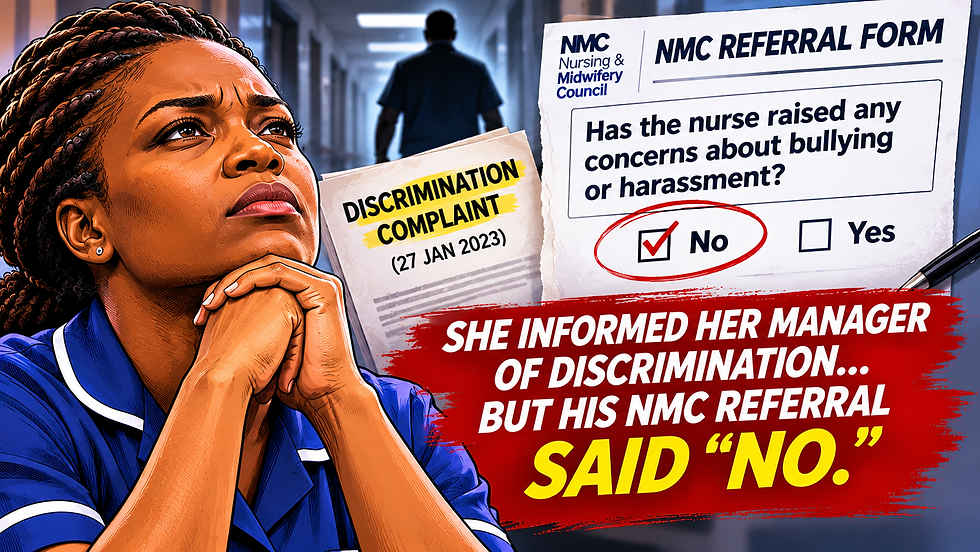
An employer's NMC referral should accurately reflect relevant concerns raised by the nurse, including complaints of discrimination.
Under questioning, he explained that he did not consider her allegations sufficiently evidenced.
The omission concerns that particular answer on the employer's referral form. It does not, by itself, establish that the NMC never became aware of the nurse's discrimination allegations during the wider proceedings.
Nevertheless, the contrast is striking.
The employer expected the NMC to investigate allegations against the Black nurse, yet her own allegations of discrimination were not separately investigated and were omitted from that referral answer.
For E4BN, this apparent imbalance goes to the heart of procedural fairness.
Who should decide whether a discrimination complaint is sufficiently credible to warrant investigation or disclosure — particularly when the decision-maker is also the subject of the complaint?
The circumstances do not establish how the omission affected the NMC's eventual findings.
But the treatment and disclosure of her complaint raise serious questions about transparency, independence and employer accountability.
A Black nurse's complaint of discrimination must never depend solely on the judgement of the person whose conduct she is challenging.
SHE WAS NOT STRUCK OFF. BUT WHAT WAS THE HUMAN COST?
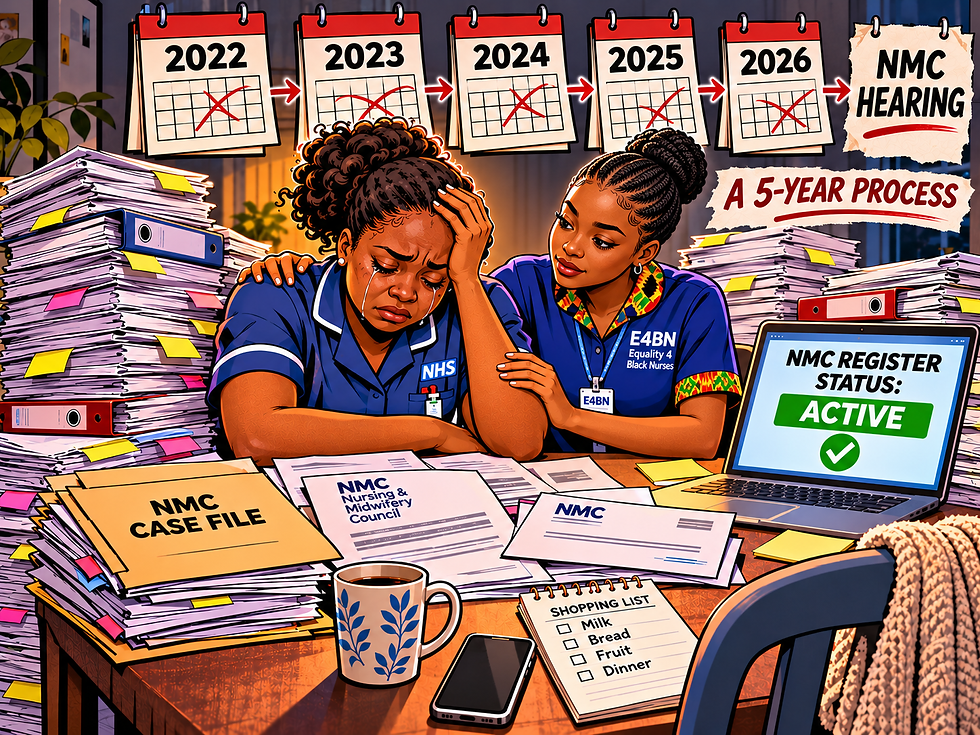
The nurse remained on the NMC register, subject to conditions of practice relating to other findings. The prolonged proceedings also carried a human cost.
On 23 October 2026, the NMC imposed 12-month conditions of practice relating to other medication allegations.
The nurse was not struck off or suspended.
The panel's findings on those incidents must be distinguished from its rejection of the allegation involving an attempted administration of the wrong medication to Patient E.
One other incident involved medication preparation in the clinical room, away from the patient, before administration. Another concerned a revised prescription that, according to witness Jamie, may not have been adequately communicated.
The panel nevertheless made findings of misconduct.
E4BN continues to question aspects of the evidence, the context and the fairness of the proceedings. Any appeal must follow the applicable legal process.
But beyond the regulatory determination lies the human cost.
Years of defending serious allegations.
The loss of employment.
Uncertainty about a professional future.
The emotional burden of knowing that patients, colleagues and future employers may hear an accusation without hearing the eventual finding.
A professional reputation can be damaged by an accusation long before the evidence has been properly tested.
And although the member was not struck off, that does not erase the years she spent living with the allegations.
TO EVERY BLACK NURSE WHO HAS EVER BEEN AFRAID TO SPEAK UP

Equality 4 Black Nurses encourages nurses to speak up about racism and seek fair, evidence-led workplace and regulatory processes.
This story will resonate with nurses who have experienced being scrutinised more closely than colleagues, felt unsupported after raising concerns or feared that challenging unfair treatment could damage their careers.
It may bring back memories of investigations, disciplinary meetings or moments when they felt that their account was not believed.
Those experiences deserve to be heard.
They do not mean every workplace investigation is discriminatory or every allegation against a Black nurse is unfounded.
But they demonstrate why confidence in fair, evidence-led processes matters.
You should not have to choose between speaking up about discrimination and protecting your professional future.
A nurse's right to report racism does not depend on having an unblemished clinical record.
A discrimination complaint must be assessed on its own evidence.
And no nurse should have to rely on the approval of the very person whose conduct they are challenging before their concerns can receive proper consideration.
TO OTHER NURSES, MANAGERS AND EMPLOYERS READING THIS
Imagine this nurse were your colleague.
Or your daughter.
Imagine she had spent years qualifying, working night shifts and caring for vulnerable patients.
Imagine she was accused of attempting to administer the wrong medication and lost her job.
Then imagine discovering years later that the regulatory panel had not found the central allegation proved.
Separately, imagine learning that her concerns about discrimination had not been subjected to a formal grievance investigation.
And that a white colleague had testified about comments dismissive of racism.
Would you want the allegations against her thoroughly investigated?
Of course.
But would you not also expect her complaints about discrimination to receive proper attention?
Racial justice is not about giving Black nurses preferential treatment.
It is about ensuring that they receive the same fairness, support and procedural protection that every healthcare professional should expect.
OUR MESSAGE TO THE NMC: FAIRNESS IS PART OF PATIENT SAFETY

Fairness is part of patient safety: fair investigations and accurate evidence help build confidence in healthcare regulation.
The NMC has a duty to protect the public.
That duty must never be compromised.
But public protection is not strengthened by incomplete referrals, unsupported allegations or investigations that fail to examine relevant evidence critically.
It is strengthened when employers and regulators distinguish between allegations and facts, examine systemic problems and scrutinise potential bias.
E4BN asks the NMC to reflect on the wider lessons of this case.
When an employer submits a referral, how effectively is the completeness of that referral assessed?
When a nurse has previously reported discrimination, how is the regulator informed of those concerns?
What safeguards exist when the manager who is the subject of a complaint is also responsible for significant disciplinary decisions?
And how can regulators maintain confidence that Black nurses' accounts are evaluated independently and fairly?
E4BN calls for clearer scrutiny of employer referral forms, safeguards for nurses who report discrimination and transparent reasoning when evidence concerning possible bias is presented during professional proceedings.
These questions are not an attack on regulation.
They are a call for regulation that nurses and patients can trust.
AN ACCUSATION IS NOT PROOF.
AN NMC REFERRAL IS NOT A FINDING OF MISCONDUCT.
The employer pursued the medication allegation.
The nurse lived with its consequences.
The NMC examined the evidence and did not find that she attempted to administer the wrong medication.
That finding deserves to be heard just as clearly as the original accusation.
Separately, the evidence about the handling of her discrimination complaint raises questions that should not be overlooked.
When a Black nurse makes a clinical mistake, she must be accountable.
When an employer makes an allegation, that allegation must be accountable to the evidence.
And when a nurse reports discrimination, that complaint deserves its own fair consideration.
Because protecting patients and protecting nurses from unjust treatment are not opposing responsibilities.
They are essential parts of a fair healthcare system.
THE QUESTION IS NOT WHETHER BLACK NURSES SHOULD BE HELD ACCOUNTABLE.
THE QUESTION IS WHETHER ANTI-BLACKNESS CAN INFLUENCE WHO IS BELIEVED, WHO IS INVESTIGATED AND WHO IS HELD ACCOUNTABLE.
A QUESTION FOR THE NURSING COMMUNITY
Have you ever witnessed a Black nurse being disciplined over a practice that other colleagues were also using?
Have you seen a workplace discrimination complaint dismissed without a separate investigation?
Have you questioned whether an employer referral told the regulator the complete story?
We invite nurses of every background, including internationally educated nurses, ward managers, educators and patient-safety professionals, to reflect on those questions.
Share this article with a nursing colleague, a ward manager or someone responsible for workplace investigations.
Not to prejudge anyone involved, but to encourage an informed conversation about fairness, evidence and the protection of nurses and patients.
Every allegation deserves proper investigation. Every nurse deserves a fair process. Every complaint of discrimination deserves to be heard. Every patient deserves safe care.
Equality 4 Black Nurses (E4BN)
Standing with nurses. Standing for justice.
Editorial note: This article is based on E4BN's account of the hearing evidence and NMC determination dated 23 October 2026. The panel found the wrong-medication allegation under Charge 3 not proved but found the medication-pot allegation proved, alongside separate findings of misconduct. E4BN's concerns about anti-Blackness and the fairness of the referral are distinguished from the panel's findings. Allegations of racial discrimination and retaliation were disputed and were not explored by the panel.
© 2026 Equality 4 Black Nurses. All rights reserved.


Comments